

Art History - July 26 revision
MASTER OF ARTS
Situated in the heart of Washington, D.C., the Master of Arts (MA) in Art History at the Corcoran School of the Arts and Design offers students exceptional access to the city’s rich cultural landscape and opportunities to put ideas into action. Students learn to apply visual and historical analysis to works of art while engaging with relevant and current theoretical and methodological approaches to research.
Just steps away from many of the world’s leading museums and galleries, students draw on permanent collections and exhibitions as an integral part of their coursework and study. The curriculum spans a broad range of art history, with particular strengths in Renaissance, Baroque, Islamic, South Asian, African, American, and modern and contemporary art.
We are committed to building and nurturing a diverse and inclusive scholarly community that serves as a catalyst for innovation, insight, and progress. Through a rigorous and supportive program, students strengthen their critical analysis, research, and writing skills while developing their individual scholarly interests.
For some students, the MA is a terminal degree that prepares them for curatorial, educational, and other professional roles in museums and galleries. For others, it provides a strong foundation for continued study in a PhD program.
PROSPECTIVE STUDENTS
Application Requirements Apply Find Funding Our Faculty Contact
CURRENT STUDENTS
INFORMATION SESSIONS
Each academic year, we offer virtual information sessions led by faculty to help prospective students learn more about our programs, faculty expertise, and application process.
What You'll Learn

- Program of Study
The program includes 36 credit hours of graduate coursework that covers a range of topics and geographic regions. During the first semester, students are required to complete the art historiography seminar (CAH 6258). Students have the option, though it is not required, of taking a language/reading comprehension examination in Arabic, Dutch, French, German, Hindi, Italian, Latin, Persian, Portuguese, or Spanish. As many as 6 credits of graduate coursework may be completed outside the department with approval of the graduate advisor.
A qualifying paper is the capstone of the final year of study. A first draft is submitted during the fall semester of the second year, or after completing 18 credits; the final draft is due the following spring semester. All qualifying papers are reviewed by a panel of full-time faculty members. Please view the M.A. Qualifying Paper Guidelines for more information.
Museum Training Concentration
Master of Arts degree candidates have the option to concentrate in Museum Training. Prerequisites and requirements are the same as those for the Master of Arts in Art History; students include in their coursework 6 credits of CAH 6299 (Museum Internship), after completion of 18 credits of art history courses.

- Skills You'll Develop
Visual Analysis — Closely examine works of art and interpret how formal elements, materials, techniques, and context shape meaning.
Research and Methodology — Locate, evaluate, and synthesize primary and secondary sources using current art history methods.
Critical Writing — Develop clear, persuasive arguments through research papers, exhibition reviews, object studies, and other scholarly writing.
Object-Based Research — Study artworks and material culture firsthand through museums, galleries, archives, and collections.
Oral Communication — Present research clearly in seminars, gallery talks, conference-style presentations, and professional settings.
Independent Scholarship — Develop original research questions and manage sustained scholarly projects from initial inquiry through final presentation.

- Learning in Practice
Students extend their learning beyond the classroom through direct engagement with museums, galleries, archives, and cultural institutions across Washington, D.C. Coursework may incorporate object-based research, visits to exhibitions and collections, conversations with curators and scholars, and opportunities to develop research connected to works of art firsthand. Students can also gain professional experience through internships and independent projects, applying their skills in museum, gallery, educational, and cultural settings while building connections within the field.
Where This Degree Can Take You
CAREER PATHS
- Curators and curatorial assistants
- Museum and gallery professionals
- Archivists and collections professionals
- Researchers and writers
- Educators and teaching professionals
- Cultural heritage and preservation professionals
WHERE ALUMNI ARE WORKING
- Curators and curatorial assistants
- Museum and gallery professionals
- Archivists and collections professionals
- Researchers and writers
- Educators and teaching professionals
- Cultural heritage and preservation professionals
CAREER PATHS
Graduates may pursue careers such as:
- Curators and curatorial assistants
- Museum and gallery professionals
- Archivists and collections professionals
- Researchers and writers
- Educators and teaching professionals
- Cultural heritage and preservation professionals
Some graduates also continue to doctoral study or pursue careers in publishing, libraries, historic sites, cultural nonprofits, and other organizations dedicated to the study, preservation, and interpretation of art and visual culture.
WHERE ALUMNI ARE WORKING
Graduates of the Art History Program have gone on to work at:
- National Gallery of Art
- Hirshhorn Museum & Sculpture Garden
- The Phillips Collection
- Washington Project for the Arts
- Smithsonian American Art Museum
- National Portrait Gallery
- Bonhams
- Sotheby's
- Nasher Museum at Duke University
- GW/Textile Museum
- Hillwood Estate, Museum & Gardens
- Dumbarton Oaks
- Transformer DC, and many more archives, museums, galleries, auction houses, universities across the globe.
'When I took my first art history course at GW, I knew immediately that this was my passion. The art history courses I took were comprehensive and interdisciplinary, and my professors always encouraged me to take my research in new directions.'
Joseph Albanese
BA ‘17

The Student Experience
Course Spotlight: Unfossilizing African Heritage
In Professor Clement Akpang’s Unfossilizing African Heritage seminar, students examine how museums can present African material culture with greater historical, cultural, and ethical responsibility. Using works from the GW Collection, students investigate how colonial collecting and display practices have often removed objects from their original contexts and obscured Indigenous meanings, symbolism, and knowledge.
As part of a multi-year sequence of courses, students conduct collections-based research and develop new approaches to interpretation grounded in context, care, and accountability. Their work has contributed to the exhibition Unfossilizing African Art at the Luther W. Brady Art Gallery and an accompanying catalogue based on student research. Students have also presented their findings at the Salon Doré and the annual conference of the Association of Academic Museums and Galleries, gaining experience in research, curatorial practice, exhibition development, and scholarly presentation.
NEXT Festival
Students at the Corcoran have exhibited their thesis work for more than 30 years. In 2011, the exhibition came to be known as NEXT in a nod to the public seeing “what’s next” in contemporary art and scholarship. In 2023, NEXT evolved into a festival format to encompass the diversity of all the school’s programs and provide more public facing programming for the DC community. See examples from past classes’ culminating projects and work.
Alumni Stories & Outcomes

“Being located in Washington, D.C., gave me the rare opportunity to engage with major legal developments in real time through the lens of art history. That experience ultimately inspired me to attend law school and pursue a career in art law. After my first year at Duke University School of Law, I interned with the Office of the General Counsel at Phillips Auctioneers in New York City, where I learned from experienced legal professionals working in-house at a major auction house. Next summer, I will return to New York as a summer associate at Simpson Thacher & Bartlett.”

“I spent two years working as an archives assistant at The Textile Museum’s Arthur D. Jenkins Library, where I gained insight into the many roles and areas of expertise required to operate a museum. That experience was invaluable as I considered my interests and career path after graduation. Most importantly, I discovered a passion for research and decided to pursue it through graduate study and opportunities in archaeology. The skills I developed in organizing, preserving, and sharing information have continued to serve me at archaeological sites around the world.”
Faculty Who Work in the Field

- Bibiana Obler
Professor Obler's research and teaching interests include modern and contemporary art and craft from the late nineteenth century to the present, with emphases on twentieth-century avant-gardes, theories of gender and cross-cultural representation, photography, and disability studies. Her book Intimate Collaborations: Kandinsky and Münter, Arp and Taeuber (Yale University Press, 2014) investigates the role of artist couples in the emergence of abstract art. Obler’s writing has been featured in American Art, Art Bulletin, Artforum, caa.reviews, The Journal of Modern Craft, and Sculpture Journal. Her research has been supported by a Mellon Postdoctoral Fellowship in the Humanities at Johns Hopkins University and a James Renwick Fellowship in American Craft at the Smithsonian American Art Museum, among others.

- Lisa Lipinski
Lisa Lipinski is art historian and specialist in the fields of modern and contemporary art. She teaches courses in the history and theory of photography, 19th and 20th-century art in Latin America, the United States, and Europe, and Art Historiography. She has taught seminars on the history of exhibitions, the art of Marcel Duchamp and the Harlem Renaissance. Her education research is focused on pedagogy and assessment in higher education, and developing students’ skills in research and writing. She has worked in major art museums: the San Francisco Museum of Modern Art, the Phillips Collection and the Smithsonian American Art Museum. She provides regular guest lectures on art and diplomacy for the Foreign Service Institute, U.S. Department of State. Dr. Lipinski is also a licensed D.C. tour guide and a member of the Guild of Professional Tour Guides, Washington, D.C.

- Clement Akpang
Clement Akpang’s teaching and research interests include modern and contemporary African art from the early twentieth century to the present, with particular emphasis on avant-gardes of 20th-century Africa, art and decolonization advocacies, and new expressions of resistance or socio-political commentary in contemporary African art. He is also interested in the cultural significance of found objects in art. His first book, Nigerian Modernism 1900-1965: Anti-Europeanization, Nationalism and Avant-garde Art (University of Calabar Press, 2019), explores the intersection of modern art, nationalism, and decolonization politics in Nigeria. His second, titled Analyzing Art: A Short Guide to Art Appreciation, Criticism and Research in Visual Arts (University of Calabar Press, 2020), is a textbook that provides practical frameworks for conducting formal and contextual analysis in visual arts for Nigerian universities and colleges.

- Alexandar Dumbadze
Alexander Dumbadze is Associate Professor of Art History. He is the author of Bas Jan Ader: Death Is Elsewhere (University of Chicago Press, 2013; paperback 2015) as well as co-editor and co-author of Contemporary Art: 1989 to the Present (Wiley-Blackwell, 2013; Korean translation, 2015). He is currently writing Jack Goldstein: All Day Night Sky. His essays and criticism have been published in a variety of national and international publications. A recipient of a Creative Capital | Warhol Foundation Arts Writers Grant, Dumbadze was a Visiting Professor of Art History at the Université Paris 8 Vincennes – Saint-Denis in 2012. He is also a co-founder and former president of the Society of Contemporary Art Historians. He teaches courses on contemporary art, theory, and historiography.
Art History in the News
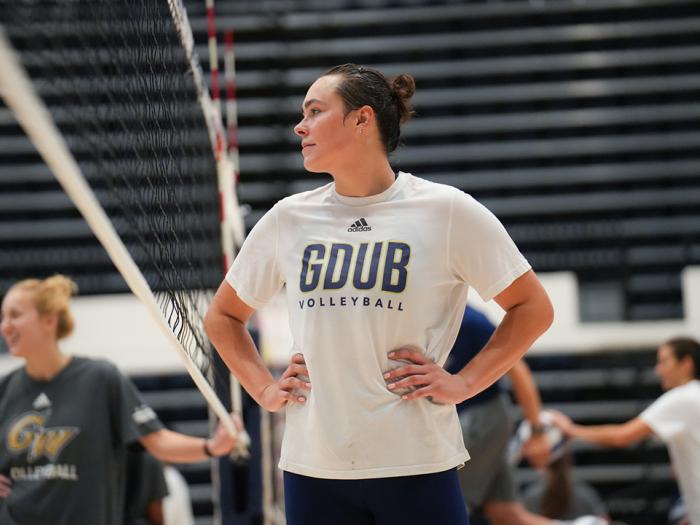
Knee Deep: Senior Serves up Sports and Art
March 21, 2025
Luther Rice Fellow MC Daubendiek, a volleyball player and artist, told the bruising story of student-athletes through photos of one body part: their knees.
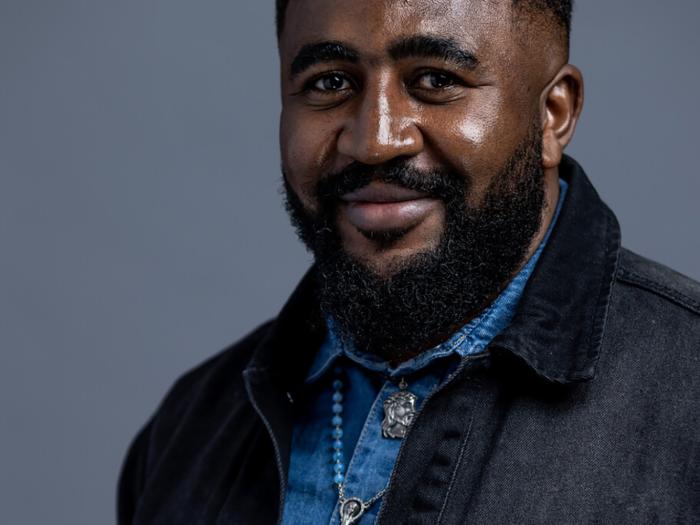
Clothing, Nationalism and Cultural Identity: The Symbolism of Traditional Attire in Defining Nigeria's Diverse Ethnic Indigenism
February 6, 2025
Prof. Clement Akpang's essay is now available in the anthology Reading the Thread: Cloth and Communication
Welcome to GW!
July 16, 2024
Ten scholars from an array of disciplines were recruited by the university to join Columbian College’s roster of permanent full-time faculty members this year. They include noted historians, authors, scientists and practitioners in numerous fields.
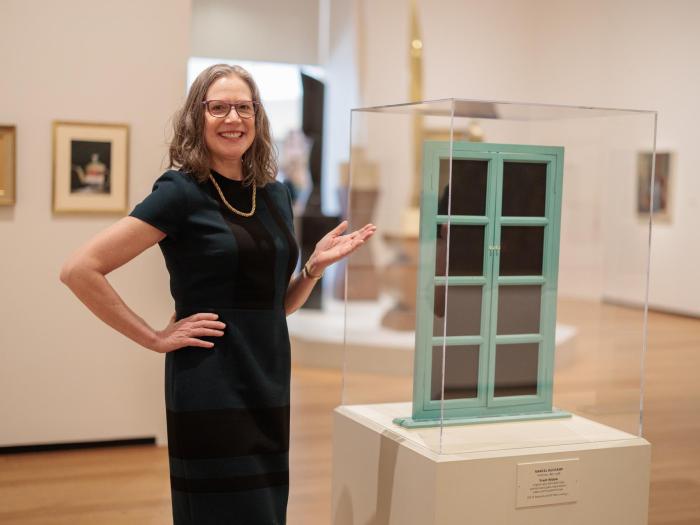
The Playful, Elusive Legacy of a Great Provocateur
March 24, 2024
GW art history students learn about Marcel Duchamp while curating an exhibit showing his influence.
